
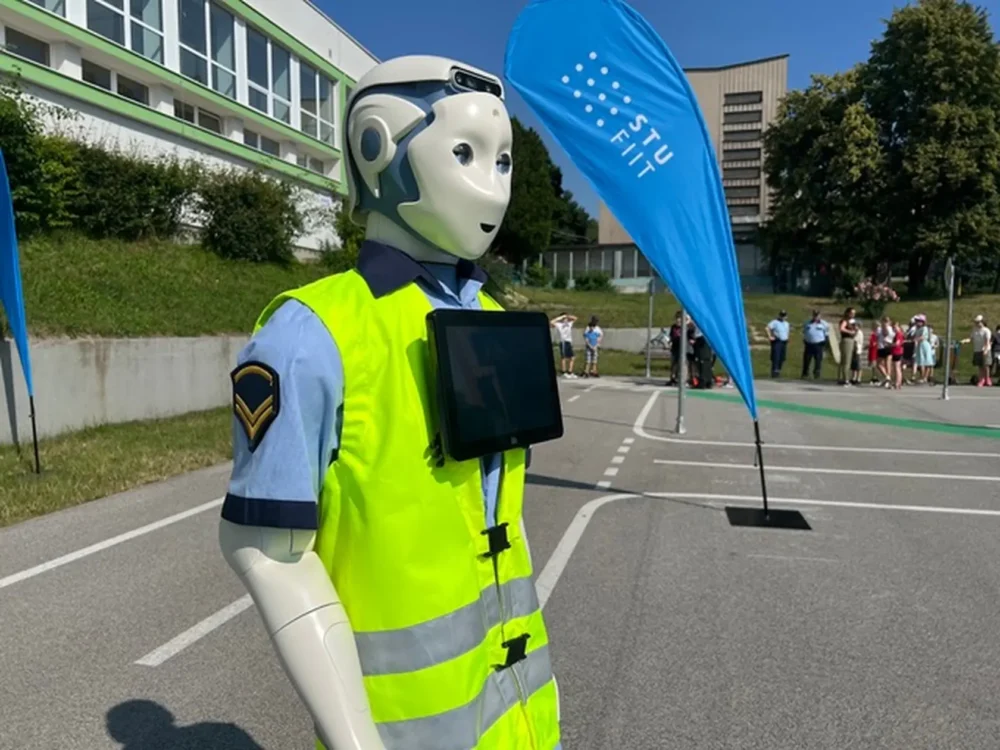
Researchers from the Slovak University of Technology in Bratislava (STU) and Karlsruhe Institute of Technology (KIT) have investigated how children perceive a humanoid robot acting as a traffic officer. The study explores whether social robots could help make pedestrian crossings safer and identifies the communication, reliability, and trust factors that future traffic-assistance robots must address.
The Problem: Connecting Traffic Technology With Human Behaviour
Connected and automated mobility increasingly relies on vehicles and infrastructure exchanging information. However, vulnerable road users—especially children—cannot be expected to access or interpret technical vehicle-to-everything (V2X) messages. They need traffic instructions that are understandable, visible, and appropriate to their situation.
Conventional traffic lights provide signals, but a mobile social robot could potentially interact more directly with pedestrians, using speech, gestures, and visual cues. Such a system might help coordinate road users in school environments or other situations where additional traffic guidance is needed.
Yet technical functionality alone is not enough. A robot must communicate clearly, behave predictably, and earn users’ trust. These requirements are particularly important when the intended users are children.
What Is New in This Research?
The study moves beyond technical demonstrations and examines children’s real-world reactions to a humanoid robot in a controlled outdoor traffic environment.
The researchers introduced a robot acting as a traffic police officer and collected open-ended feedback from 84 schoolchildren aged 9–13. Based on the responses, they developed a semantic annotation framework and identified four sociotechnical dimensions shaping children’s perceptions:
- System reliability and safety – whether the robot appears capable of recognizing situations and guiding children safely.
- Communication clarity and modalities – whether instructions are understandable through speech, gestures, and visual signals.
- Cognitive and social interpretation – whether children perceive the robot as a machine, helper, or authority figure.
- Functional and developmental expectations – what children expect the robot to do and how they believe it should improve.
The contribution is therefore not simply the use of a humanoid robot for traffic guidance. It is a structured, child-centred analysis of how technical behaviour and social interpretation interact in a safety-critical setting.
How Was the Study Conducted?
The experiment took place at a children’s traffic playground next to a primary school in Karlova Ves, Bratislava. The robot, a PAL Robotics ARI platform dressed as a police officer, used arm gestures, a display, and spoken Slovak commands to signal when children should stop or cross.
The participants included 39 children aged 9–10 and 45 aged 12–13. After interacting with the robot during a road-safety activity, they answered open-ended questions about trust, communication, their initial reactions, expected functionality, and possible improvements.
The robot was teleoperated using a Wizard-of-Oz approach, rather than operating autonomously. This allowed the researchers to study the interaction while limiting technical uncertainty and potential safety risks. The children were not told that the robot was being remotely operated.
The research team then analysed the responses qualitatively, using iterative coding to identify recurring themes and organize them into the four sociotechnical dimensions.
Key Findings: Trust Depends on More Than Technology
The results show that children assessed the robot holistically. They considered not only what it did, but also whether its instructions were clear, whether it appeared competent, and what social role it seemed to represent.
Trust was not automatic. Among classifiable responses, distrust was more common than explicit trust in both age groups. This highlights the importance of reliable behaviour and understandable signals rather than assuming that a humanoid appearance will make a system trustworthy.
Clear communication matters. Children frequently referred to spoken instructions and sound. The findings also point to the value of combining speech with gestures and visual cues, particularly when outdoor noise or sunlight can make individual communication channels difficult to perceive.
Children assign social meaning to robots. Participants interpreted the robot as a machine, an interactive actor, a helper, or a police-like authority figure. Its role and the surrounding context influenced how its actions were understood.
Expectations change with age and experience. Younger children more often described the robot in social and interactive terms, while older children more frequently raised questions about competence, reliability, and technical capability. Participants also suggested improvements, particularly smarter behaviour and clearer communication.
An additional insight concerns the environment around the robot. The presence of uniformed police officers and technical staff may have influenced children’s perceptions of its authority and reliability. Trust in a robotic system can therefore depend partly on the people and institutions associated with it.
Why Does This Matter for Intelligent Transportation Systems?
The findings suggest that future traffic-assistance robots should be designed around the needs of human road users, not only around sensing, control, and automation capabilities.
For school-route applications, this could mean combining recognizable traffic-officer gestures with clear spoken instructions and visible signals. Robot behaviour should be predictable, and its operational state should be communicated in a way that children can understand.
The work also highlights a broader challenge for cooperative and automated mobility: safe interaction requires bridging the gap between technical systems and people who may have no direct access to digital vehicle communications.
Social robots could eventually complement existing traffic infrastructure, but their role, authority, and limitations must be communicated clearly.
Research Quality and Limitations
The study is valuable because it examines interactions with a functioning robot in an outdoor setting and includes feedback from children themselves. Its qualitative approach provides detailed insight into perceptions that may be missed by technical performance measures alone.
The paper was accepted for publication in IEEE Intelligent Transportation Systems Magazine, a peer-reviewed publication focused on intelligent transportation systems.
The findings should nevertheless be interpreted as exploratory. The experiment took place in a controlled traffic playground, not in unrestricted street traffic. The robot was teleoperated rather than fully autonomous, and the visible presence of police officers and technical staff may have affected participants’ responses. In addition, one researcher performed the response coding, so inter-coder reliability could not be assessed.
Consequently, the study does not demonstrate that robotic traffic officers already improve real-world road safety. Instead, it identifies human factors and design considerations that need to be investigated further before such systems can be deployed.
Publication Details
Title: Social Robotics for Safer School Routes: An Exploratory Study With a Humanoid Robot and Children
Authors: Nina Masarykova, Matej Halinkovic, Andy Comeca, Maximilian Schrapel, Marek Galinski, and Alexey Vinel
Publication: IEEE Intelligent Transportation Systems Magazine
DOI: 10.1109/MITS.2026.3728480
Conclusion
Social robots may offer a new way to support safer interactions between children and traffic systems, but their effectiveness depends on much more than their ability to perform gestures or issue commands. Clear communication, perceived reliability, predictable behaviour, and an understandable social role are all essential.
By studying how children respond to a humanoid robotic traffic officer, the research provides an initial evidence base for designing human-centred robotic assistance for future intelligent transportation environments.