
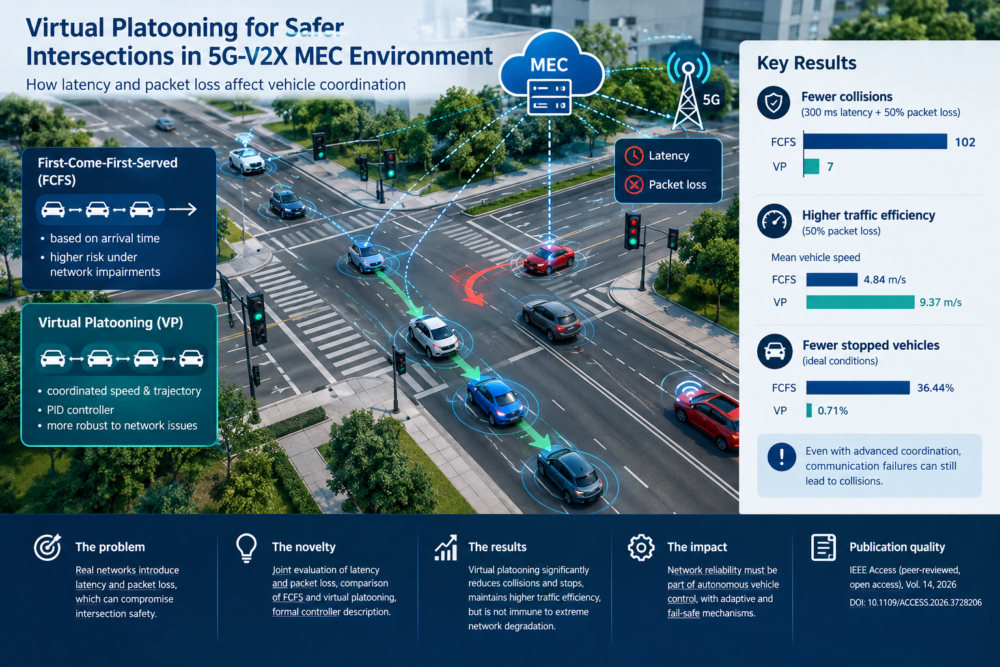
Researchers from the Faculty of Informatics and Information Technologies at the Slovak University of Technology in Bratislava (FIIT STU) have investigated how communication delays and packet loss affect the safety and efficiency of connected and autonomous vehicles at intelligent intersections. Their study, published in IEEE Access, shows that virtual platooning can substantially improve traffic flow and reduce collision risks compared with conventional queue-based control. However, the findings also reveal that even advanced coordination algorithms cannot guarantee safe operation when communication quality deteriorates severely.
The Problem: Autonomous Vehicles Depend on Reliable Communication
Connected and autonomous vehicles can coordinate their movements through vehicle-to-everything (V2X) communication and centralized control hosted at Multi-access Edge Computing (MEC) infrastructure. By exchanging information about their positions and speeds, vehicles can approach and cross intersections without relying exclusively on conventional traffic lights.
The challenge is that real communication networks do not always deliver information on time. Delayed or lost messages can leave the central controller working with outdated vehicle positions, while vehicles continue moving. At an urban driving speed of 46.8 km/h, a vehicle travels approximately 1.95 metres in 150 milliseconds and 3.9 metres in 300 milliseconds. Both distances are significant when vehicles are coordinated around a predefined safety gap of just three metres.
Although many intelligent intersection management algorithms have been evaluated under ideal communication conditions, their robustness under simultaneous latency and packet loss remains a critical concern. Understanding these effects is essential before centralized, communication-dependent control can be considered for real-world deployment.
What Is New in This Research?
The paper, “Impact of Latency and Packet Loss on Virtual Platooning-Based Intersection Control in 5G-V2X MEC Environment,” by Jozef Juraško, Rastislav Bencel, and Peter Trúchly, extends the authors’ earlier conference research by introducing a direct comparison between two different intersection control strategies under the same network impairments.
The first strategy, First-Come-First-Served (FCFS), assigns crossing priority according to vehicle arrival time. The second, Virtual Platooning (VP), organizes approaching vehicles into a virtual platoon and continuously adapts their speeds and accelerations to maintain safe distances and coordinate their trajectories.
The study’s main contributions are:
- A joint evaluation of communication impairments. The researchers investigate end-to-end latency and packet loss both separately and in combination, including severely degraded network conditions.
- A formally described virtual platooning controller. The approach incorporates a proportional-integral-derivative (PID) controller for continuous inter-vehicle distance regulation, together with feed-forward information from the platoon leader.
- A systematic comparison of safety and efficiency. The evaluation measures collisions, near-collision events, mean vehicle speed, and the percentage of stopped vehicles.
- Identification of operational limitations. The results quantify how communication degradation can undermine centralized coordination, even when an advanced control algorithm is used.
Rather than proposing an entirely new intersection management paradigm, the work provides a more comprehensive assessment of how control strategy and communication reliability interact in a 5G-V2X MEC environment.
How Was the Study Conducted?
The researchers developed an integrated simulation framework combining SUMO and Veins for traffic modelling with OMNeT++, INET, and Simu5G for network simulation. A custom MEC application handled vehicle coordination at a four-way intersection.
The experiments modelled vehicles travelling at 13 m/s, with a nominal minimum inter-vehicle distance of three metres and a message transmission rate of 30 Hz. The evaluation covered ideal communication, latency scenarios extending to 150 and 300 milliseconds, packet-loss rates of 5%, 10%, 20%, and 50%, and combinations of latency and packet loss.
The experimental design comprised 30 configurations, each repeated three times, resulting in 90 individual simulation runs. This enabled a systematic comparison of FCFS and virtual platooning under identical conditions.
Key Results: Virtual Platooning Is More Robust
The results consistently favour virtual platooning in terms of safety and traffic efficiency, although its advantages diminish as communication conditions become more severe.
1. Fewer collisions and near-collision events
Under ideal communication conditions, FCFS recorded four collisions and eleven near-collision events. Virtual platooning eliminated the four reported collisions and reduced near-collision events to four.
The difference became more pronounced under degraded communication. With 300 ms latency, FCFS recorded 59 collisions, compared with ten for virtual platooning. Under 50% packet loss alone, the corresponding collision counts were 77 and 13.
The most challenging combined scenario further illustrates this difference. With 300 ms latency and 50% packet loss, FCFS recorded 102 collisions, whereas virtual platooning recorded seven. Despite this substantial improvement, the remaining collisions demonstrate that better coordination does not eliminate the underlying safety risk.
2. Higher traffic efficiency and fewer stops
Virtual platooning also maintained a more continuous traffic flow by adapting vehicle speeds instead of repeatedly requiring vehicles to stop before entering the intersection.
Under ideal network conditions, mean vehicle speed was reported to be 54.68% higher than with FCFS. The percentage of stopped vehicles decreased from 36.44% with FCFS to just 0.71% with virtual platooning.
Under 50% packet loss, virtual platooning maintained a mean speed of 9.37 m/s, compared with 4.84 m/s for FCFS. The percentage of stopped vehicles was 1.29% for virtual platooning, compared with 50.58% for FCFS.
These findings indicate that continuous trajectory and speed adaptation can preserve traffic throughput even when the communication system becomes unreliable.
3. Communication quality remains a fundamental safety constraint
The experiments show that latency and packet loss can interact to produce substantially worse outcomes than either impairment considered in isolation. Outdated position information and missing control messages compromise the controller’s ability to coordinate vehicle movements safely.
The authors identify latency around 300 ms as a high-risk condition because the resulting vehicle displacement can exceed the predefined safety gap. Virtual platooning demonstrates considerable resilience at packet-loss rates up to 20% in the tested scenarios, but its performance also deteriorates under extreme network degradation.
These values should be understood as scenario-specific findings, not universal safety thresholds for all autonomous driving systems.
Why Does This Matter?
The findings are relevant to the development of connected, cooperative, and automated mobility, where the performance of communication networks is inseparable from the performance of vehicle control systems.
For intelligent transport infrastructure, the implication is clear: optimizing a control algorithm alone is insufficient. Future systems should incorporate real-time awareness of network conditions, adapt their control behaviour to communication quality, and provide fail-safe mechanisms when reliable coordination is no longer possible.
The authors identify several promising directions for further research, including dynamic PID gain scheduling based on network quality and hybrid control architectures that combine V2X communication with onboard sensor information. Such approaches could help vehicles maintain safe operation when centralized communication becomes unreliable.
Research Quality and Limitations
The paper was published in IEEE Access, a peer-reviewed, fully open-access IEEE journal covering a broad range of engineering and computing research. Its publication provides an established international venue for the work, and the study addresses a relevant practical problem through a clearly structured experimental comparison.
The research is strengthened by its integrated traffic and network simulation, explicit mathematical formulation of the virtual platooning controller, systematic variation of communication parameters, and direct comparison of two control strategies. The publication also discusses its limitations rather than presenting the simulation results as proof of real-world safety.
Several limitations remain important. The evaluation uses a single four-way intersection and a simplified traffic configuration. Vehicle localization is assumed to be perfect, and the PID parameters are tuned under ideal communication conditions and held constant throughout the experiments. Each configuration is repeated three times, which supports basic consistency checks but provides limited evidence for broader statistical generalization. The study also does not experimentally validate the results on physical vehicles or address communication security threats.
Consequently, the numerical results should be interpreted as evidence of relative robustness within the evaluated simulation scenarios, rather than as direct predictions of collision rates in real traffic.
Publication Details
Title: Impact of Latency and Packet Loss on Virtual Platooning-Based Intersection Control in 5G-V2X MEC Environment
Authors: Jozef Juraško, Rastislav Bencel, and Peter Trúchly
Affiliation: Faculty of Informatics and Information Technologies, Slovak University of Technology in Bratislava, Slovakia
Journal: IEEE Access, Volume 14, 2026
DOI: 10.1109/ACCESS.2026.3728206
The study was supported in part by the Programme Slovakia project on AI-driven 5G/6G integration with edge computing and by the APVV project addressing legal and technical challenges of smart mobility and road safety.
Full paper: Read the article via DOI
Conclusion
This research demonstrates that virtual platooning can substantially improve the safety and efficiency of intelligent intersections compared with simple arrival-order-based control, even when communication is impaired. Its broader contribution is to show that network reliability must be treated as an integral part of autonomous vehicle control, rather than as an independent infrastructure concern. For future 5G- and 6G-enabled mobility, robust coordination will need to be complemented by network-aware decision-making and onboard fail-safe capabilities to ensure safety under adverse operating conditions.